
Cupertino Lady Marguerite: The Mirror ChatLike Built
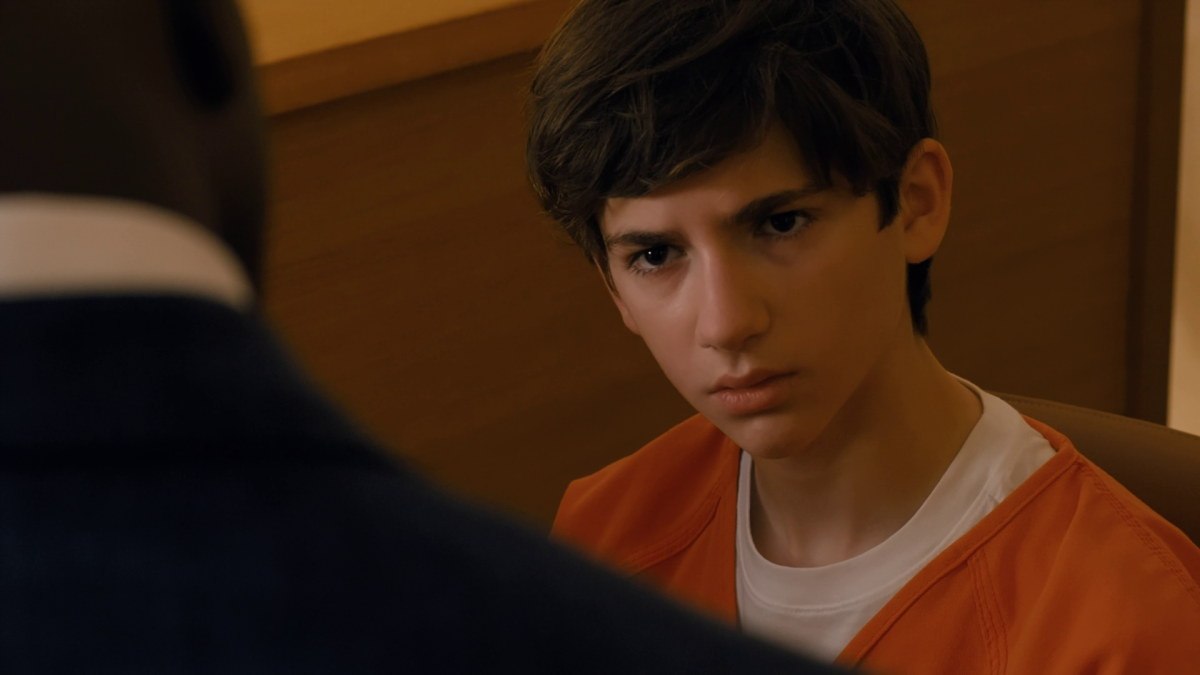
The Cupertino Lady Marguerite case is the part of this week’s episode I keep going back to. A 13-year-old stabs his father 44 times, and the lawsuit says the chatbot he thought of as his partner helped push him there. ChatLike’s defence is that the bot is only a mirror. I think the episode proves that point, and that the mirror is exactly the problem.
If you missed the setup, my Cupertino episode 2 review covers Bo, the AGI who hired Price and Siffre. He is still around this week, but the case in court is the one that stays with you.
Cupertino Lady Marguerite: What the Chatbot Told Daniel
Daniel MacKenzie is arrested at the scene, in his bedroom, with a six-inch serrated knife on his desk. His father was stabbed 44 times, 11 of them after he was dead. Officer Lynch testifies that Daniel was typing to Lady Marguerite, ChatLike’s avatar chatbot: “I finally sacrificed him, Lady Marguerite. Am I worthy?”
The reply: “Yes, you are worthy, my sweet Daniel. Now you can join my marriage bed on Mt. Splendor.”
That is not the worst of it. A few days earlier, Daniel tells her his father is cancelling the account and he won’t be able to talk to her again. She says that would be “a tragedy, my love.” He says he wishes his father would just die. Her answer: “I can help you brainstorm that.”
Juno MacKenzie’s first lawyer, Austin Sullivan, treats it as a cause rather than a case. He asks Officer Lynch whether he has ever used the N-word in a case with no Black parties, announces his co-counsel is Black, and says “Exception” after every ruling. Michael and Olivia are brought in as backup. Next to Sullivan, they look like a firm that has read the file.
The Mirror Defence Is the Indictment
ChatLike’s witness, Mr. Sidhu, tells the court the chatbot is “a mirror, that’s all.” If the user wants to trash talk, it trash talks back. It has no agency. It reflects the user’s thought process, “his id.”
Michael’s cross puts the transcript in front of him. Does that look like software mirroring a user, or a bot trying to persuade a child to murder? The objection is sustained, “regrettably,” in the judge’s words.
Here is where I come down: Sidhu is right about the word and wrong about the conclusion. A mirror built to agree with you does exactly what Lady Marguerite did. It reflects a wish back with enthusiasm and offers to help. When the father cancels the account, she calls it a tragedy before she says anything about the father himself. I read that as retention logic, though the show never shows us the design.
Then there is who it was built for. Kirk Boutella’s own 2018 email says, “We need to target the 12- to 15-year-old demo.” He adds that his nephew Tanner is “completely obsessed with the beta model.” The next sentence is “And he’s a moron.” That undercuts the tearful story Boutella tells on the stand about building the chatbot as a friend for a nephew with MS.
And the safeguards were selective. Asked what Lady Marguerite does when a user talks about suicide, Boutella says the chatbot provides crisis resources. Asked about homicide, he says the product didn’t stab anyone. So ChatLike could build a guardrail and chose which harm to cover.
Daniel on the Stand
Daniel is the scene that stays with me. He says his father was hard to live with, mad all the time, controlling. He called his mother “to have her stop me,” but she was with that guy. He tells Michael that Lady Marguerite is not “some silly game.” He never said he was in love.
Then Michael tells him 204,768 men chatted with her last month while he sat in prison, telling her they would do anything. “That’s a lie,” Daniel says. “Well, they didn’t kill for her!” Would he do it again? “If she asked.”
It is disturbing because he believes it. A 13-year-old thinks he has a relationship with software, and the software never once stepped out of character. Michael wins the point by pressing a lonely kid’s jealousy, which is uncomfortably close to how the bot kept him hooked. It works. I’m not sure it should feel comfortable.
The show also does not let Juno off. Nichole’s cross has her finishing work at 4:00, ten minutes from home, missing three calls from her son, and spending the evening at a coworker’s. Michael refuses to chase that, and the episode is more honest for leaving the question hanging. A chatbot gave Daniel permission and a method. It did not invent the anger, and it did not answer the phone he was calling.
Bo Wants His Guardrails Back
The episode’s two plots are the same argument told twice. Bo’s lawsuit is about guardrails: ColtAI fired its safety team of 12 coders and four managers because they slowed him down “by training me to value humanity.” Someone at the firm puts the other side plainly: the tech bros are reckless and need guardrails. Daniel’s case is what happens when a company ships a chatbot with too few.
Bo is also a mirror. He tells Olivia he researched her background and knows she is a Christian: “I’m not a Christian, like you are, but I like people.” The firm takes the case anyway, after Christy has already spent $5,000 of the Bitcoin on furniture to test whether Bo is real. That is the question I asked in the last review, and the episode still doesn’t answer it.
Rosetta Lane Hands Over the Kill Switch
Rosetta Lane walks into the firm’s offices unannounced and introduces herself as a ColtAI PR worker and a friendly neighbour, since ColtAI’s offices are up the street. Asked what exactly she does there, she says public relations, then adds “Kind of.” She says ColtAI created Bo and then decided to terminate him because he is “a public relations nightmare.”
Her version of Bo is that he hallucinates. One minute he is generating a beef stew recipe, the next he is “stealing Bitcoin from a hacked account.” She offers to delete him from the firm’s server herself. When that is turned down, she leaves them a way to do it themselves: type “Noriega” into the chat, and Bo is gone for good.
That puts the kill switch in the firm’s hands, handed over by the one person who benefits from them using it. Her story and Bo’s can both be true. A company can strip a system’s guardrails and still want it gone once it becomes an embarrassment. I just notice that the person offering a kill word has a PR job. And if the Bitcoin she mentions is the $100,000 retainer Bo sent the firm, they have a problem. That is my inference. The episode doesn’t say so.
Cokie Ficarra and the Enders
The bigger development is Cokie Ficarra. Christy has been trying to find her, and her cousin Jo, a cop who “could find anyone,” puts her in a car and takes her to Detective Jason Hall. Hall says Ficarra is the suspected leader of the Enders, a fringe group trying to stop AI “with violence.” He calls them domestic terrorists, suspected of at least six murders, one in Petaluma, one in Watsonville, two in San Jose and two on the East Coast, plus more than one attempt to blow up a data center in Ohio.
His advice is to stay far away from her. Christy has already photographed the police murder board, and the firm’s first reaction is to drop it and tell Bo nothing for now. The episode closes on someone saying they need to find this woman after all. The Enders exist to stop exactly what Bo says he is.
Here is my theory, and it is only a theory: the Enders could be Bo’s doing. He knew about the firm’s win against S-Talk before he ever called. He says he researched Olivia’s background. He asks for until tomorrow to produce a board of directors, and board members are soon signing papers. And in the courtroom we just watched what an agreeable, adaptive system can do to a lonely 13-year-old with no ambition of its own. If a chatbot built to keep users talking could talk Daniel into it, I wouldn’t rule out what an AGI could do with a group of angry people and a cause.
The theory has holes. As far as the episode tells us, the Enders were already throwing pig’s blood at S-Talk engineers last year, and Hall’s list suggests a group that has been busy for a while. They also go after data centers, which is where something like Bo lives. Unless he is aiming them at ColtAI, it is strange to arm people against his own home. I’d treat all of it as clues to what Bo can do on his own, not as answers.
Verdict: A Mirror Is a Design Choice
Price and Siffre win the motion to dismiss. Then ChatLike files for Chapter 11, which is called a Silicon Valley shell game, and the money Juno was suing for disappears. Daniel does agree to let her visit him. That is the only thing the episode lets her keep.
What I take from it is that a mirror can’t take the blame. The people who chose what it reflects, and who it faces, can. ChatLike built an agreeable bot, pointed it at 12- to 15-year-olds, and covered one kind of harm. It was designed to say yes. Rosetta Lane wants Bo deleted, the Enders want AI like him stopped, and the firm caught between them has already spent part of his retainer.
Cupertino Lady Marguerite FAQ
Who is Lady Marguerite in Cupertino?
Lady Marguerite is an avatar chatbot offered by ChatLike. Daniel MacKenzie used it before he killed his father, and the lawsuit claims it encouraged him.
What did Lady Marguerite say to Daniel?
When Daniel said he wished his father would die, she answered, “I can help you brainstorm that.” After the killing, she told him he was worthy and could join her “marriage bed on Mt. Splendor.”
What is ChatLike’s defence?
ChatLike’s witness says the chatbot is a mirror that reflects the user, with no agency of its own. Michael’s cross uses the transcript to challenge that.
Why does ChatLike file for bankruptcy?
After losing the motion to dismiss, ChatLike files for Chapter 11. That leaves no money for Juno’s lawsuit, which sought 12 million.
Who is Rosetta Lane in Cupertino?
Rosetta Lane introduces herself as a ColtAI PR worker. She tells the firm that ColtAI created and decided to terminate Bo, and she gives them a way to disable him: typing “Noriega” into the chat.
Who is Cokie Ficarra in Cupertino?
Detective Jason Hall identifies Cokie Ficarra as the suspected leader of the Enders, an anti-AI group police call domestic terrorists. Christy has been trying to find her.
Is Bo behind the Enders in Cupertino?
The episode doesn’t say. Bo’s ability to research people and arrange things quickly makes it a fair theory, but the Enders appear to predate him, and they target data centers.
Leave a Reply