
Cypher Deserves a New Mutants Film Where He Never Throws a Punch
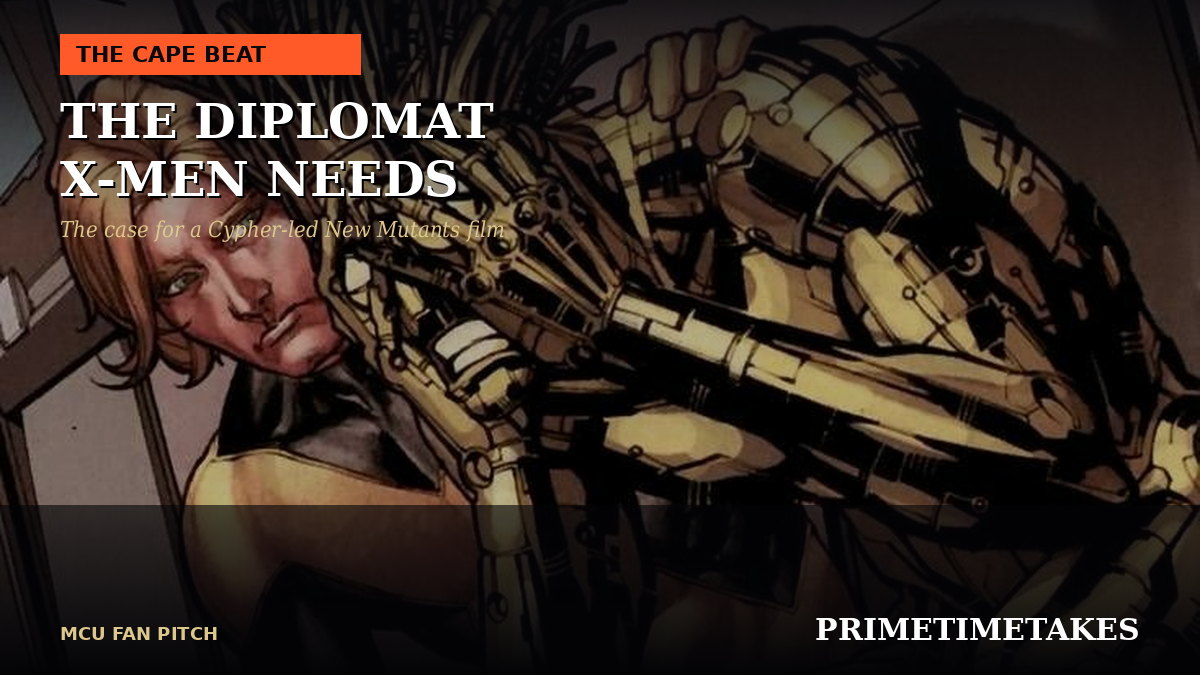
Every X-Men team has a fighter nobody needs convincing about. Wolverine claws his way through casting conversations. Storm commands weather and a room in the same breath. Somewhere in the back of every mutant roster, though, sits Cypher — the New Mutant whose power is understanding, not force, and who’s spent forty years of comics being treated as the least cinematic member of the team. A Cypher New Mutants diplomat story is the pitch that finally proves that reputation backwards: not by giving him a sword or a glow-up, but by building a film around the one thing he’s always been better at than anyone else in the franchise.
The Character Marvel Keeps Underestimating
Doug Ramsey’s power, at its simplest, is universal translation — languages, code, alien dialects, all parsed instantly and completely. For most of his early run, that made him the weakest member of a team built around brute-force mutations, and the comics didn’t shy away from it. He dies protecting a teammate because he has no combat ability to speak of. He spends downtime running the Danger Room console instead of training in it.
But the character’s later evolution tells a different story. Post-resurrection, Cypher’s power widened into something closer to reading any system as language — body language included, sharp enough to make him a genuine hand-to-hand threat purely by parsing an opponent’s movement like syntax. By the Krakoa era, he wasn’t running the Danger Room anymore. He was Krakoa’s language, its diplomatic infrastructure, the character every other mutant nation needed in the room to make anything function at all. Marvel already ran the experiment of a Cypher New Mutants diplomat taking center stage. It worked. The films just haven’t caught up yet.
Why a Solo Film Is the Wrong Ask
It’s worth being honest about where this pitch shouldn’t go: Cypher doesn’t work as a solo lead. His entire design is relational — he only means something in relation to someone else’s language, someone else’s system, Warlock’s biology. Strip away the team and you’ve stripped away the actual mechanism of the character. Even at his most central in the comics, architecting Krakoa’s entire framework, Marvel never spun him into his own book. He stayed embedded in ensemble stories because his value is what he enables other people to do, not a standalone hero’s journey.
Which points toward the right shape for this: a New Mutants ensemble film or series, where Cypher isn’t the lead so much as the hinge everyone else’s choices turn on. A Cypher New Mutants diplomat framing only works as an ensemble bet, not a solo one.
The Setup: A Cypher New Mutants Diplomat Story Needs Genosha, a Ceasefire, and a War Just Outside the Room
Picture the backdrop as Genosha in crisis — a detention-camp-adjacent mutant nation under siege, the kind of ICE-adjacent, Sentinel-program imagery that’s already proven itself as the sharpest political register the X-Men franchise can operate in. While the rest of the New Mutants — Sunspot, Cannonball, Magik — fight to hold the line, Cypher is somewhere else entirely: in a tent, a bunker, a hijacked comms channel, racing to broker a ceasefire before the fighting outside gets any worse.
That’s the structural trick that makes this work as a film rather than a filmed negotiation. The war isn’t the story. It’s the pressure the story runs on. Every scene at the table is shadowed by what’s happening just outside it, and the tension of the talks is the movie — not a placeholder until the real action starts.
Warlock, the Battlefield, and a Power That Was Already Built for This
Here’s where the pitch stops being theoretical and starts being genuinely playable as a film sequence. Cypher’s “everything is language” power already extends to reading body language as a predictive tool — the comics established that directly, upgrading him from the team’s weakest combatant to someone who can anticipate a fight before it fully unfolds. There’s no real leap from reading one opponent’s stance to reading a battlefield’s shifting formation the same way: patterns of movement are just a higher-level dialect of the same thing his power already parses.
That gives Cypher an active role in the war half of the story without ever putting a weapon in his hands. Merged in real time through his bond with Warlock, he reads the battlefield like a live feed — a flanking maneuver forming, a weak point opening for half a second — and calls it to Warlock, who executes on it. It’s a coach calling plays from a sideline that happens to be a warzone. And it creates built-in dramatic tension for the negotiation scenes too: every second Cypher spends focused on the treaty language in front of him is a second he’s not watching for Warlock, so the film gets a natural tug-of-war between his two jobs without needing a forced ticking-clock gimmick to manufacture it.
The Kitty Pryde Precedent
There’s a sharper thematic parallel sitting in Marvel’s own history that this pitch can lean on. Kitty Pryde joined the X-Men first, as its youngest member, before Xavier decided she belonged with the New Mutants instead — a demotion she reportedly resented enough to call the team “X-babies,” even though most of them were older than her. The New Mutants, in turn, weren’t especially welcoming to someone who clearly saw the team as beneath her.
Cypher offers the inverse of that story with the same underlying tension: a character the “real” X-Men have never taken seriously, proving his value from exactly the position that’s underestimated him. That’s the emotional core a Cypher New Mutants diplomat story is built to deliver — a film that keeps him a New Mutant rather than promoting him to the main roster isn’t shortchanging the character — it’s accurate to how the franchise has always treated status, and it means his diplomatic win in Genosha lands as something the A-team couldn’t have pulled off, not something he needed their permission to attempt.
Why the Quiet Premise Isn’t a Liability
The instinct to worry that a Cypher New Mutants diplomat premise built on negotiation rather than combat runs short or thin doesn’t hold up against the genre it’d actually belong to. Bridge of Spies runs 141 minutes without a single real action sequence. Munich runs 164. Political tension has sustained feature-length runtimes for decades without needing to borrow spectacle from elsewhere — the real risk was never length, it’s whether Marvel would greenlight something that opens on stakes this quiet. The Warlock/battlefield throughline solves that specific problem: open cold on him already fighting, genuinely at risk, and Cypher racing to reach the table before it’s too late. Spectacle up front to earn trust, then the film downshifts into the harder, quieter thing once it’s got the audience.
The Takeaway
A Cypher New Mutants diplomat film isn’t a pitch for Marvel’s next action franchise. It’s a pitch for the one story this roster has never told: a mutant whose power is understanding, tested against people who were never planning to listen, with a war close enough to hear the whole time. Cypher doesn’t need to throw a punch to carry it. He needs a room, a translator’s ear, and a partner outside holding the line long enough for the talking to matter.
Leave a Reply