
JMS’s Spider-Man Run: Ezekiel’s Moment of Decision, Aunt May’s Reveal, and Where It All Went Wrong
J. Michael Straczynski’s Amazing Spider-Man run (1999–2006) is one of those stretches of superhero comics that gets relitigated every few years, usually starting with someone insisting it’s underrated and someone else countering with “yeah, except for that story.” Both things are true. It’s a run with a genuinely ambitious core idea, some of the finest quiet character work Spider-Man has ever gotten, and one retcon — on par with some of Marvel’s other messiest character overhauls — so badly conceived it’s still cited as a cautionary tale two decades later. Worth separating out which is which.
The Totem Mythology: A Real Swing, Not Just Filler
JMS’s biggest structural move was reframing Peter Parker’s origin as something closer to fate than accident. Ezekiel Sims — a wealthy businessman with powers identical to Spider-Man’s — shows up early in the run to explain that the spider that bit Peter wasn’t mutated by radiation at all. It was trying to pass on its power before it died. Peter isn’t a science accident; he’s a “totem,” plugged into a mystical hierarchy that also explains why so many of his rogues are animal-themed. They’re imposters, and on some level they sense that Peter isn’t.
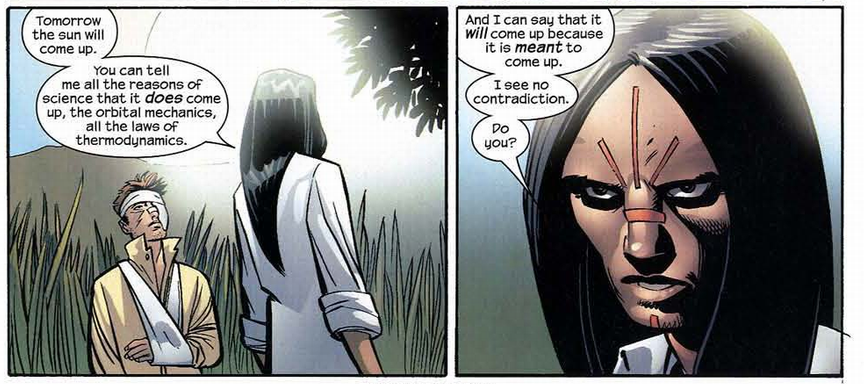
It’s a divisive idea — some readers think it over-mystifies a hero who’s supposed to work at street level — but it’s a genuine thematic swing rather than a retread of “great power, great responsibility.” And to JMS’s credit, the run doesn’t ask you to abandon a rational worldview to buy into it. There’s a quiet exchange late in the arc where Ezekiel Sims tells Peter the sun will come up tomorrow — not because of orbital mechanics and thermodynamics, though those are all true, but because it’s meant to. “I see no contradiction. Do you?” That’s the run’s whole argument in miniature: science and myth aren’t competing explanations here, they’re two registers describing the same event.
Ezekiel as Mentor-Antagonist — And His Real Function
Ezekiel Sims isn’t a clean ally for most of the run. He’s an exposition device early on, a mentor-antagonist through the middle stretch, and finally, in “The Book of Ezekiel” (Amazing Spider-Man Vol. 2, #506–508), the run’s most affecting piece of writing.
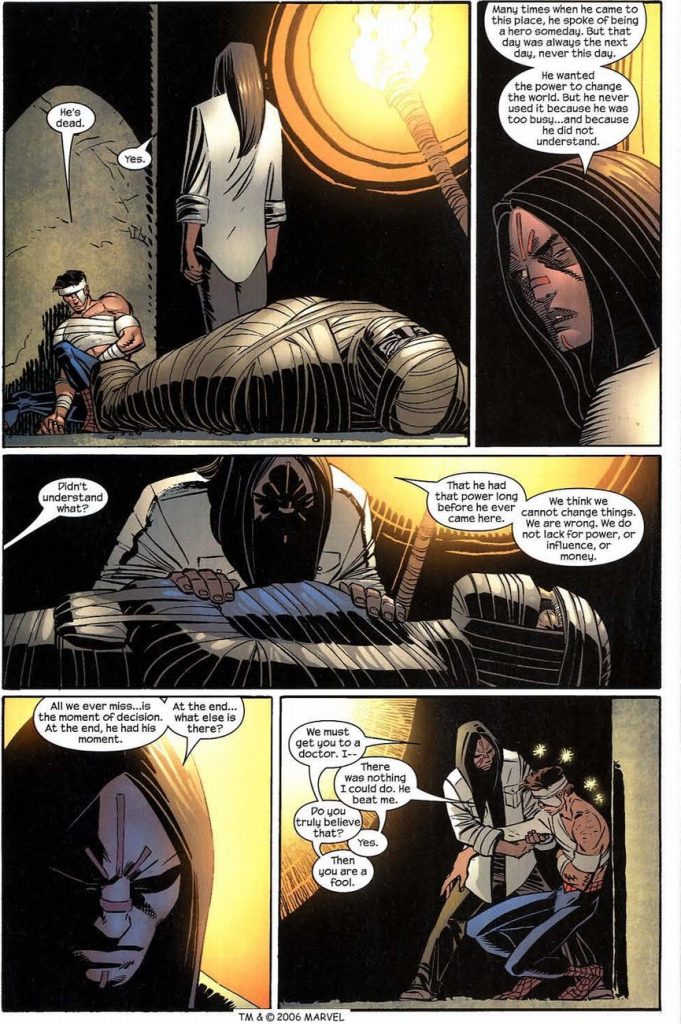
He dies protecting Peter from Morlun, a totem-hunting predator — but the arc’s best scene isn’t the fight. It’s the funeral afterward, where a totem tribesman delivers Ezekiel Sims’ eulogy to a beaten, bandaged Peter, and it’s not really an act of mourning. It’s an indictment. Ezekiel Sims had totem power for decades before he ever met Peter, and he squandered nearly all of it chasing wealth and status. “He wanted the power to change the world. But he never used it because he was too busy… and because he did not understand.” The line that lands hardest: “That day was always the next day, never this day.”
What follows is the closest thing the run has to a thesis statement, and it’s delivered with real coldness — not sentiment. “We think we cannot change things. We are wrong. We do not lack for power, or influence, or money.” And then: “All we ever miss is the moment of decision. At the end, what else is there?”
It’s a harder, more adult ending than the genre usually allows a mentor figure. No “his sacrifice wasn’t in vain.” Just a life mostly wasted, redeemed by one act at the very end — delivered by a character with no emotional stake in Peter’s grief, which is exactly why it lands as judgment rather than eulogy.
Aunt May: The Best Use of a 60-Year-Old Secret
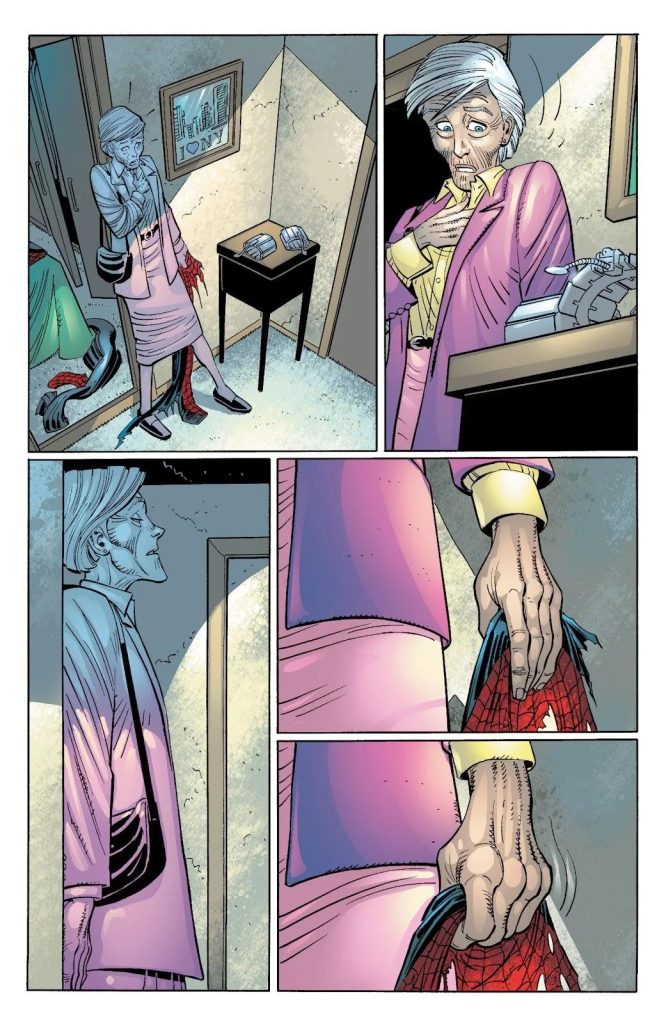
If Ezekiel Sims’ death is the run’s best plot beat, May finding out Peter is Spider-Man — in Amazing Spider-Man Vol. 2 #38, “The Conversation” — is its best character beat, and arguably the high point of the entire run.
What makes it work is restraint. May isn’t played as a fool who never noticed anything, and she isn’t reduced to shock-then-forgive. She’s been quietly building her own theory for years — at one point admitting she’d guessed Peter was gay, which explained his aloofness and secrecy about as well as anything else available to her. It’s a good joke, but it’s not just a joke: it establishes that she was paying close attention the whole time, just working from limited information. “My nephew has powers and fights crime in a mask” was never going to be the more parsimonious guess.
The fallout is handled with the same restraint. May doesn’t get a single big dramatic gesture — she cancels her subscription to papers like the Daily Bugle over their Spider-Man coverage, and sends letters suggesting talk shows interview him. Small, practical loyalty, scaled to what’s actually in her power. It’s some of the best writing May has ever gotten, precisely because it treats her as a full adult with agency rather than a source of anxiety for Peter to manage.
Where It Broke: Sins Past
Then there’s the run’s low point, and it’s a low point specifically because it doesn’t just misjudge tone — it requires Gwen Stacy to have been someone she was never written as. (For the full rundown of the storyline’s twists, and why it’s remembered as one of the more infamous retcons in Spider-Man history, it’s worth reading up on the fan reaction that followed.)
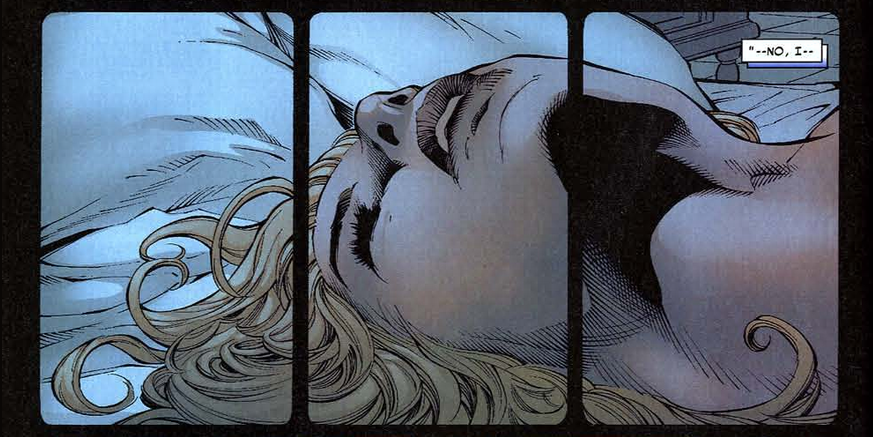
“Sins Past” (2004) retroactively gives Gwen a secret affair with Norman Osborn — decades her senior, and established elsewhere in the mythos as his own son’s father — with twins conceived before her death and aged to adulthood via the goblin serum. The early chapters build real mystery. The reveal is where it collapses, and collapses on two separate fronts: Gwen was written for years as devoted specifically to Peter, with nothing in her characterization suggesting otherwise, and the story never honestly reckons with the age and power dynamic it’s actually depicting, framing it as tragic romance instead. Straczynski reportedly objected to the premise and was overruled editorially — which tracks, since the story reads like it was built backward from a twist that needed solving rather than forward from anything true about who Gwen was.
Brand New Day Never Had a Chance — And Not Just Because It Was Bad
What came after JMS is its own conversation, and worth being fair to: One More Day and Brand New Day weren’t simply a worse version of the same thing. They were an explicit reaction against it — Joe Quesada’s stated reasoning was that Spider-Man works best as a young, striving, unresolved everyman, and a happily married Peter was too “complete” to sustain that. Faster, lighter, done-in-one stories, deliberately built to not chase what JMS had been doing.
That’s exactly why it never had a fair shake with readers who’d followed Peter from teenager to married adult across decades. The payoff of watching him actually arrive somewhere — a stable marriage, an aunt who finally knew the truth, adult stakes — was the point for that readership. Undoing it to court a theoretical younger reader wasn’t neutral toward the audience that had spent years investing in the earlier version. Even people involved in Brand New Day have since described it candidly as a tradeoff rather than a clean win, and there’s no real counterfactual showing the alternative would have failed. The run wasn’t just tonally different from JMS’s — it was built on the premise that what longtime readers valued most about the previous decade was the thing standing in the way of new readers, which was never going to land as anything but a loss for one side of the ledger.
Where to Read It: Key Issues
- Amazing Spider-Man Vol. 2 #30 — Ezekiel Sims’ first appearance, and the introduction of the totem mythology
- Amazing Spider-Man Vol. 2 #38, “The Conversation” — Aunt May learns Peter is Spider-Man
- Amazing Spider-Man Vol. 2 #506–508, “The Book of Ezekiel” — Ezekiel Sims’ death and funeral, and the arc’s thesis statement
- Amazing Spider-Man Vol. 2 #509–514, “Sins Past” — the Gwen Stacy/Norman Osborn retcon
- Amazing Spider-Man #544–545, “One More Day” — the end of the JMS era and the run-up to Brand New Day
The Case for a Reread
JMS’s run rewards a second pass more than most. The totem mythology, May’s slow-burn awareness, Ezekiel Sims’ whole arc — none of it fully pays off until you’ve seen where it’s going, and it’s the kind of run where the quiet scenes (a funeral, a conversation about sunrise) end up mattering more than any of the big fights. Worth returning to, Sins Past excepted.
What’s your take on JMS’s Spider-Man run — underrated classic or overrated by nostalgia? Drop a comment below and let us know. And if you want more Cape Beat breakdowns like this one, follow Prime Time Takes on Threads, Bluesky, and Facebook.
Leave a Reply