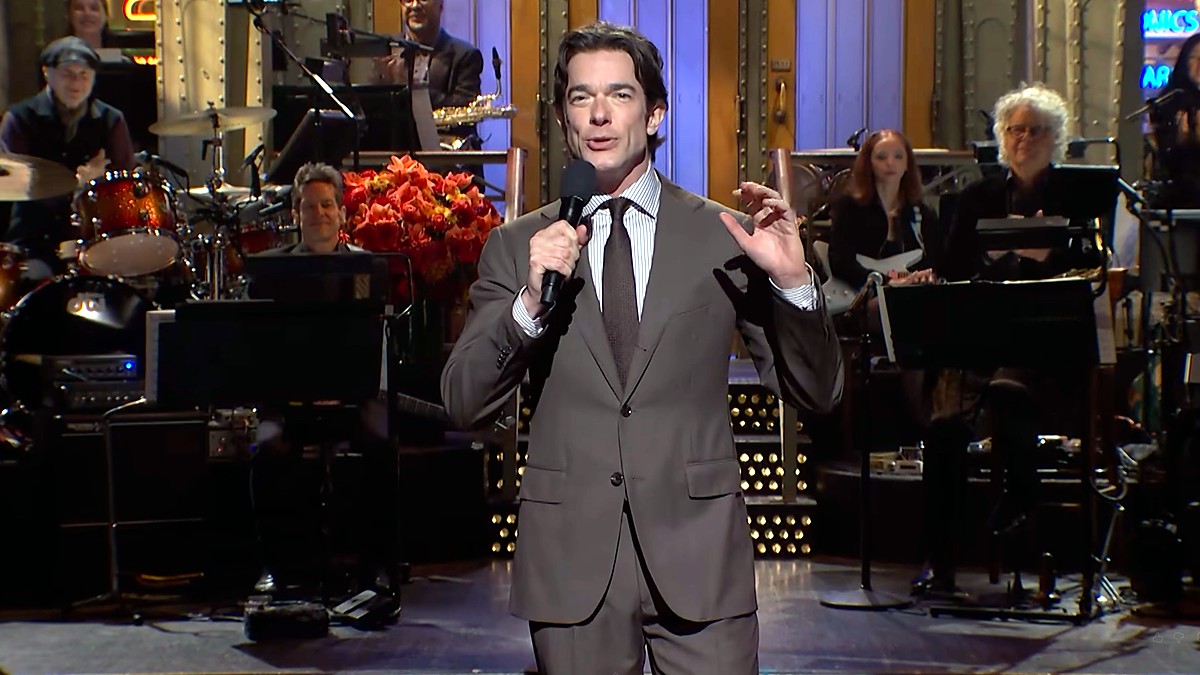
John Mulaney’s seventh time hosting Saturday Night Live opens with a cold open built on the week’s biggest tech scandal and a monologue that spends most of its time on dads. The cold open is the tighter piece of writing. The monologue is looser, but it has the best individual lines, and it saves its best material for a story about Robert F. Kennedy Jr. and a voicemail. Phoebe Bridgers is the musical guest.
John Mulaney’s SNL Monologue: Diagnosing Dad
Mulaney starts with a self-deprecating warm-up (he’s “happiest when I’m on television,” and now that he’s a host it’s “like there’s no host”) and then gets to the premise: he has decided his dad is autistic, and “it’s cleared up everything about our childhoods.” The target is not autism. It is the generation of men now saying on the news that “there weren’t autism cases when I was a boy.” His answer: “Yes there were, you butterfly-collecting freak.” Whether that framing sits comfortably with you is a fair question, but the joke is aimed at the denial and at his own family, not at the diagnosis.
The examples are what make it work. He compares the realisation to the end of The Usual Suspects, then runs through the evidence: the time his father shook hands with a baby (“Pleasure to meet you, baby”) and the time he walked into a four-year-old’s bedroom to say, “You have a lot of trash in your garbage can.” That one is a man trying to make conversation, and Mulaney lets the line sit before explaining it. His dad’s career is the second half of the bit: Roman Catholicism and corporate law, “rules, rules, rules,” and a hostile-takeover speech that ends with “How come your faces are making water?” The tag, “He’ll find out right as this airs,” is the cleanest button in the opening stretch.
The “greatest generation” grandfather section is shorter and meaner. The tomato sandwich cut the same way every day, the war story answered with “No, no, no, no,” and “Back when men were men” are all familiar phrases that Mulaney turns into diagnostic criteria.
Baby Boomers, Gen Z and the Furniture Item
Then he turns the argument around: “everything you say about Gen Z is actually true of you. It’s 1 to 1.” The best evidence comes in three lines. Trying to take an iPad from a 78-year-old man means he’ll “grip it like a smart gorilla at a good zoo.” His mother has three friends banned from Facebook Marketplace for “hate speech in the comments of a furniture item,” and, in what might be the best line of the whole monologue, “it wasn’t for sale.” And the “kids are too sensitive” complaint gets answered with a fantasy phone call from a mother who skipped no chance to be dramatic: all she wanted was her kids home so she could give a weird Thanksgiving toast that leaves out one significant other on purpose.
It is a well-built section because each example is specific and each one makes the same point from a different angle. It is also the part of the monologue that most clearly sounds like Mulaney: observational, exact, and slightly too pleased with its own precision.
The RFK Jr. Voicemail
The transition from parenting is announced by Mulaney himself: “Here’s a bad transition.” Toddlers at playdates, he says, keep turning out to have scratchy, hoarse voices (“Do you live alone? Were you almost reincarnated all the way, old man, but they stopped at voice?”), and the punchline is a child answering, “I’m the US Secretary of Health and Human Services.”
The impression that follows is broad (“Please let me be in charge of your bones and your tummy”), with a Robitussin-and-telekinesis bit that goes into pamphlets in a rental car. The more interesting part is what he does after the impression. He says that “no one likes that guy anymore,” that “your thing can’t be the measles,” and then tells a story from a decade of knowing Kennedy. Kennedy ran the Riverkeepers, whose job was keeping the Hudson clean, which Mulaney describes as a river whose “native fish is ‘tied off used condom.'” Every year Kennedy asked the comedians to do his benefit, and they would “all go bomb.” One year a woman told Mulaney that Kennedy would call to thank him, and the call arrives as a voicemail from an unknown number: “John, it’s Bobby…” Mulaney’s reaction: “I got butt dialed by the mom from Goonies.”
This works because it’s a story with a beginning, a middle and a button, and because it lets the political point (Kennedy runs the country’s health policy) sit underneath a personal anecdote. The one caution is that the story’s claims about Kennedy’s old environmental work are Mulaney’s punchlines, not reporting.
Cold Open: Tech Billionaires and the Spy Problem
The cold open is set at the CIA, where a briefer gathers Peter Thiel, Sam Altman, Dario Amodei, Mark Zuckerberg and Elon Musk to discuss “an extremely sensitive matter of national security”: “America needs you to learn the difference between a woman who would actually want to have sex with you and a woman who is clearly a spy.” According to Bleeding Cool, the cast is Ben Marshall as Thiel, James Austin Johnson as Altman, Jane Wickline as Amodei, Andrew Dismukes as Zuckerberg and Jeremy Culhane as Musk.
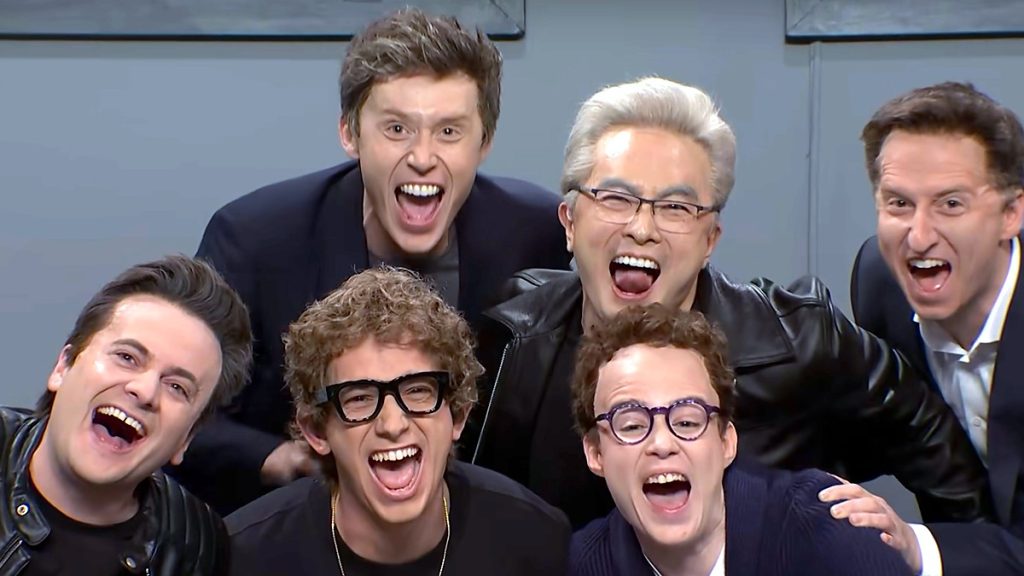
The sketch is anchored in real news. Nvidia CEO Jensen Huang admitted an affair with an executive at the Singaporean company Megaspeed, whom the Trump administration reportedly suspects of passing information to Chinese intelligence, according to PC Gamer’s summary of the Axios and New York Times reporting. China denies the allegation. Nvidia then announced in an SEC filing on November 12 that Huang had resigned as president, CEO and board member effective immediately, with CFO Colette Kress as interim CEO. So when the briefer says “former Nvidia CEO Jensen Huang resigned this week,” the sketch is simply correct.
The construction is a lecture that keeps being derailed by its audience, and it has a very good engine in the Venn diagram: beautiful women on one side, “people who would be interested in your shared opinions and interests” on the other, “There is no overlap. So if someone is both of these things, they are a what?” “An angel.” “No. They are a spy.” The follow-up, a second diagram of beautiful women and people who like the Metaverse, is a clean joke about Zuckerberg: “Where’s the circle?” “Let’s zoom in. And boom! Yep, it’s just you.”
The other good beat is the briefer’s speech about how disorienting it must be “to go from these bug-eyed little weirdos to being gods,” which includes “never in the history of our species have people as pale and as strange as you survived.” Elsewhere the writing hits the week’s other news. “Name one time technology has let us down” gets “yesterday, when every plane in America was grounded,” then “the day before that, when Microsoft Outlook went dark.” Coverage of the sketch, including The Hollywood Reporter’s headline, ties those lines to the recent FAA ground stop and Microsoft outage. Thiel gets the Antichrist joke, Altman and Thiel point out that they’re gay, and Amodei’s contribution is a polite, awkward “May I interest you in an industry secret?” that gets a chorus of “No!” It’s a mild role for him, but it is consistent with the sketch’s idea that the least confident person in the room is the safest.
Bowen Yang’s surprise return as Huang is the sketch’s last turn: “It’s me. It’s me. Jensen ‘Hide Your Wife’ Huang.” He leans into the scandal (“When you invite Jensen over, you know what’s about to go down. The S&P 500,” “I’m into BDSM — Breakin’ Da Stock Market”) and then the actual lesson: “Remember, women don’t like guys like us. That’s how we became guys like us.” Musk, undeterred, tries to relate (“we both have, like, cool leather jackets”), starts making Harley noises, and gets cut off by “Bad Elon!” and the “Live from New York” cue. It’s the same gag the sketch used earlier, and it still works, because the show has spent the whole sketch setting him up as the one man in the room who can’t be told anything. Musk was also the target of last week’s Weekend Update bit.
Verdict
The cold open is the better-structured piece. It has a real news hook, a clean central joke and a cameo that earns its place, and the writers resist the easy version where the billionaires are just villains. The monologue is looser and longer, and the RFK Jr. section is partly a segue to Mulaney’s favorite subject, himself. Even so, “it wasn’t for sale” and the voicemail are lines I would repeat to someone, which is the real test for a monologue. Compared with Shane Gillis’s gas station egg monologue earlier this season, Mulaney is more of a storyteller and less of a single-joke architect, and it plays well to his strengths.
Which line from Mulaney’s monologue is staying with you, and did the Jensen Huang cold open work for you? Drop your take in the comments below.
Follow Prime Time Takes on Threads, Bluesky and Facebook for more.


