
Star Trek: Strange New Worlds Season 4 Finale Review — “Tomorrow’s Enterprise”
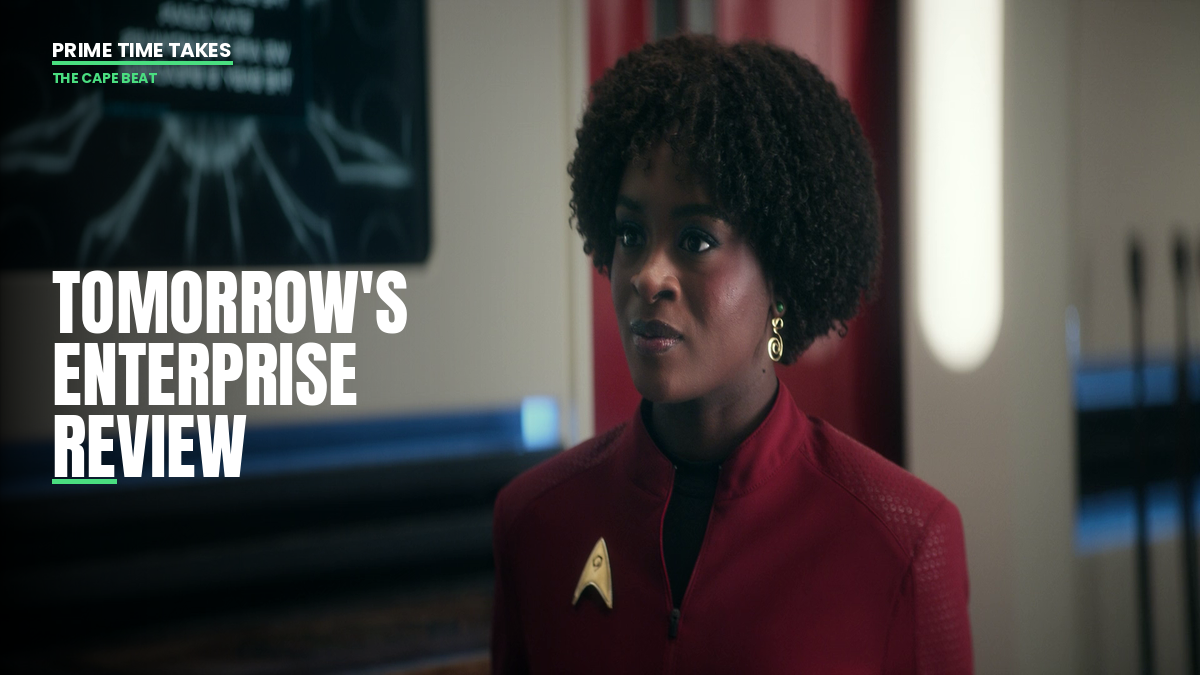
Tomorrow’s Enterprise Strange New Worlds review — SNW goes full two-timeline Uhura in a season finale that earns its emotion even when the plot mechanics get a little too cosmic for their own good.
Tomorrow’s Enterprise Strange New Worlds Review: Two Uhuras, One White Hole
Let’s get the obvious out of the way first. “Tomorrow’s Enterprise” is a Yesterday’s Enterprise reference. The show knows it, you know it, and frankly the title is doing a lot of heavy lifting before a single frame rolls. That’s both the strength and the slight weakness of this episode in miniature: it leans hard on legacy resonance, and it mostly — mostly — earns it.
The setup is classically clean Star Trek. The Enterprise is studying a white hole (the theoretical reverse side of a black hole, per Spock’s best educated guess), Uhura picks up a strange musical pattern emanating from it, and before anyone can do anything useful, an energy pulse rocks the ship. Uhura hits her head. And then she starts hearing Scotty screaming over the comm — except Scotty is fine.
What follows is a dual-timeline structure in the TNG tradition: present-day Uhura on Pike’s Enterprise studying the white hole, and a future Uhura — one year ahead, slightly different haircut, uniform shading towards what Nichelle Nichols wore in TOS, now in a relationship with Scotty — on Kirk’s Enterprise studying the black hole on the other side. Through quantum entanglement, the two Uhuras make contact. The mission: figure out what the anomaly is, why it nearly killed Scotty in Uhura 2’s timeline, and how to fix it from both ends simultaneously.
Celia Rose Gooding carries this episode on her back, and she does it. Playing against herself with two versions of the same character at different emotional points in life — one still figuring things out, one who’s already lived through loss and knows what she wishes she’d done differently — is the kind of assignment that exposes an actor if the material isn’t there to support it. Here, it mostly is. The episode turns the bittersweet nature of the passage of time into its raison d’être via a time travel story that sees Uhura team up with a version of herself from the near future. The scenes where the two Uhuras bicker, advise each other, and eventually reckon with what they each had and lost are the genuine emotional core of the hour.
The Future Preview That Actually Lands
The show has been building toward Kirk’s captaincy since before you could spell “Starfleet.” If you’ve been following along with our Strange New Worlds Season 4 episode guide, you know the season has been setting this transition up one genre experiment at a time. With Uhura quantumly entangled with herself from a mere year in the future, everything IS different — Pike’s off the ship and Kirk is the Captain. Seeing the crew in recognizable TOS formation — Paul Wesley’s Kirk running a tighter, more seasoned bridge, Chapel’s hair doing the Majel Barrett thing, Boyce as ship’s doctor — delivers the kind of earned goosebump moment SNW has always been capable of when it trusts its own setup.
The visual language is smart here too. The edits layering shots of each Uhura moving in parallel are among the best in the episode — director Chris Fisher uses color temperature and costume design to keep the timelines visually distinct in a way that never loses you, which matters a lot with this many moving parts. Fangirlish noted the same, calling the parallel editing masterful.
The poker throughline — future Uhura has learned to bluff in the intervening year, and it matters for the resolution — is a bit on the nose given how much TNG‘s finale leaned on the poker table as a symbolic space, but it’s not wrong. And the emotional beats with Pike in the future timeline land quietly, the way the best Pike scenes this season have.
Where It Loses the Thread: Space Baby
The space baby is a problem.
Not because the idea of a cosmic birth event disrupting a starship is inherently ridiculous — this is Star Trek, and stranger things have happened before breakfast. The problem is that the connection between the baby’s “contractions” and Scotty’s death in the alternate timeline is underexplained in a way that feels like a script draft that needed one more pass. How does Uhura figure out that the two are connected? The episode skips past this more than it resolves it, and the translation — “We are the midwives. The baby is breeching.” — lands with a thud when it arrives because the emotional build-up hasn’t been earned on that particular thread.
The cosmic beings explaining themselves in voiceover at the end, while Uhura floats inside the anomaly surrounded by glitter, is the kind of sequence that requires maximum goodwill from the audience. The “embodiment of evil” stuff from the Season 3 finale was arguably worse, but the space baby and cosmic midwife material still feels unavoidably wonky for a finale that otherwise has its feet planted in actual character work. AIPT’s review put it well: the episode demonstrates that when SNW’s writers put their minds to it, they can deliver fairly decent Star Trek — the problem is the season as a whole has been too wildly disjointed to fully capitalize on that.
The Scotty/Uhura relationship — quietly established as a real romantic throughline in the future timeline — also suffers slightly from being introduced and resolved in the same episode. While Uhura and Martin Quinn’s Scotty have good chemistry, more runway for that pairing would have helped.
Season 4 Verdict: Better Than It Had Any Right to Be
This Tomorrow’s Enterprise Strange New Worlds review lands somewhere in the “earned but imperfect” zone — which is also roughly where Season 4 as a whole sits. More consistent than Season 3, more standout episodes, a better grasp on what it wants to be. “Orders of Magnitude” two weeks ago was one of the season’s best hours. “Tomorrow’s Enterprise” doesn’t quite reach that height, but does something arguably more necessary for a penultimate season: it gestures toward where this is all going.
Ironically it probably could have made a pretty great series finale too. Though the name evokes TNG’s “Yesterday’s Enterprise,” it shares plenty of DNA with that show’s time-hopping series finale — right down to the poker playing as symbolic throughline.
Season 5 will be a shortened six-episode final run, and that compression makes what this episode sets up feel loaded in a good way. Kirk’s Enterprise is no longer a fantasy or a flash-forward — it’s the destination. What happens to La’An? What does Ortegas leaving for the Academy mean? The finale raises these questions without being obligated to answer them yet, and that’s the right move.
One last thing: the dual Uhura voiceover that closes the episode works. It shouldn’t, and then it does. That’s the clearest verdict on “Tomorrow’s Enterprise” as a whole — it shouldn’t work as much as it does, and then somehow, it mostly does.
Rating: B+
Got thoughts on “Tomorrow’s Enterprise” and where Season 5 needs to take us? Drop them in the comments below. You can also follow Prime Time Takes on Threads, Bluesky, and Facebook — and let’s talk Trek before the final season beams in. If your read on the Tomorrow’s Enterprise Strange New Worlds review falls somewhere different, I want to hear it.
Leave a Reply